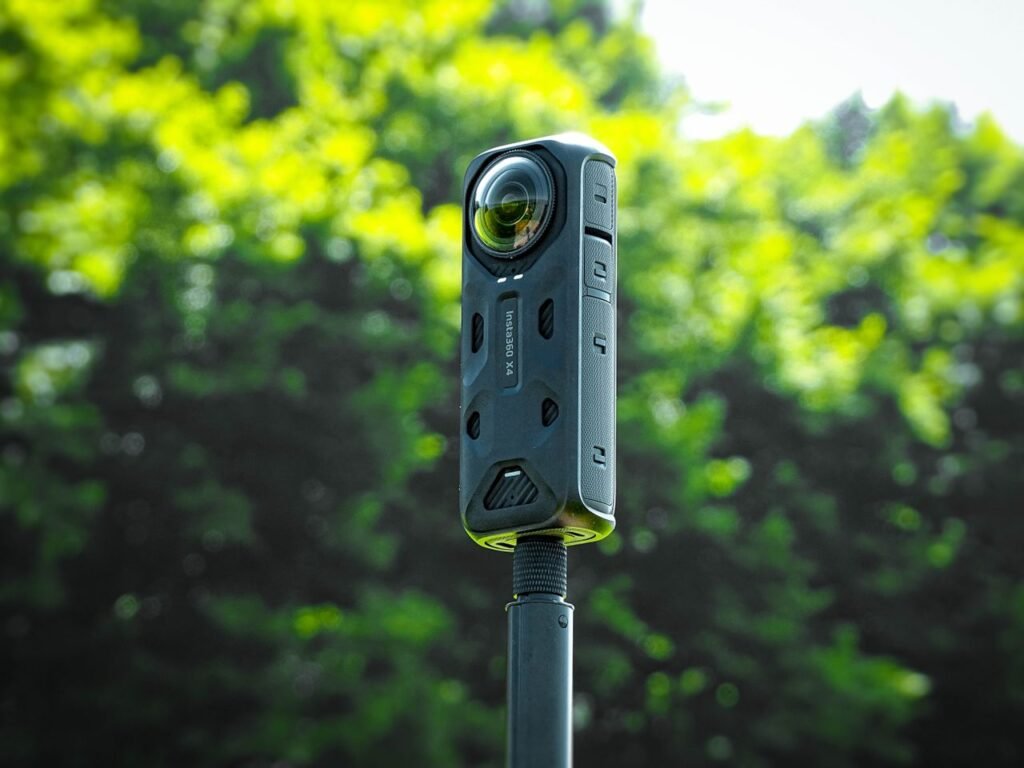
Action cameras have been a favorite choice for travel, sports and outdoor video for years. But 360 cameras have changed the way travelers can capture an experience by recording virtually everything around the camera and allowing the shot to be reframed later.
That creates an interesting question: if you want a small camera for vacations, adventures or social media, should you buy a traditional action camera or a 360 camera?
Quick answer: Choose a traditional action camera if you want a simple workflow, conventional point-of-view video and minimal editing. Consider a 360 camera if you value creative angles, third-person perspectives and the ability to choose your framing after recording. Neither format is automatically better — they solve different problems.
What Is an Action Camera?
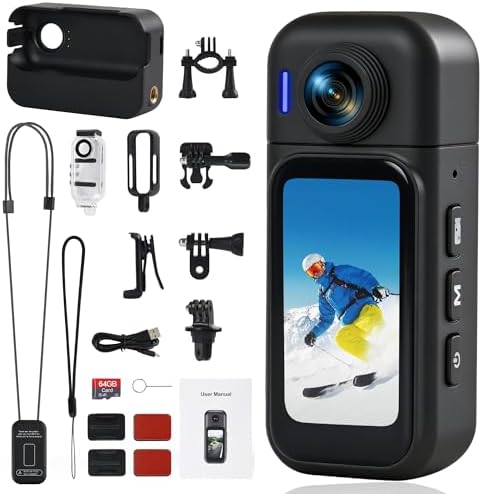
An action camera is a compact video camera designed to capture wide-angle footage in situations where a traditional camera may be inconvenient.
They are commonly associated with travel, cycling, skiing, hiking, water activities, vehicles and other situations where portability matters.
You point the camera toward the subject and record essentially the composition you want viewers to see.
That simplicity is one of the biggest advantages of the traditional action-camera format.
What Is a 360 Camera?
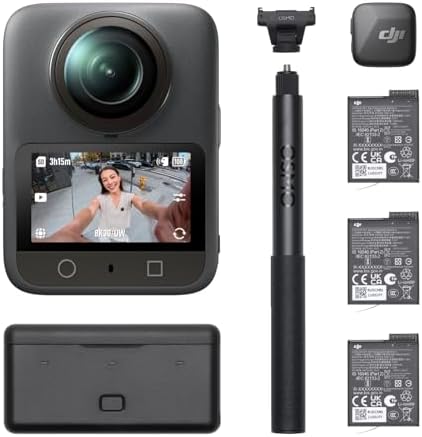
A consumer 360 camera typically uses lenses pointing in different directions to capture the environment around the camera.
Software then combines, or “stitches,” those views into spherical footage.
Instead of committing to one direction while recording, you can later select where the viewer should look.
With a traditional action camera, you normally frame the shot before recording. With a 360 camera, you can capture the surrounding scene and make many framing decisions afterward.
360 Camera vs Action Camera: Quick Comparison
| Feature | 360 Camera | Action Camera |
|---|---|---|
| Capture Direction | Captures a much broader surrounding view | Primarily records where the camera is pointed |
| Reframing | Major advantage | More limited |
| Editing | Usually more involved | Generally simpler |
| Traditional POV | Possible, depending on setup | Excellent fit |
| Third-Person Effects | Major strength | More difficult |
| Lens Protection | Requires extra care with exposed lenses | Often easier to protect |
| Simple Vacation Clips | Creative but may require processing | Very convenient |
| Creative Flexibility | Very high | High, but within the camera’s field of view |
1. The Biggest Advantage of a 360 Camera: Reframing
Imagine walking through an incredible city while filming yourself.
With a traditional camera, you decide where the camera points while recording.
If something interesting happens behind the camera, you may miss it.
A 360 camera changes the workflow. Because a much larger surrounding scene is captured, you can often decide later whether the final video should look forward, backward, sideways or toward yourself.
This process is commonly known as reframing.
2. Shoot First, Frame Later
This is one of the most attractive ideas behind 360 video.
Instead of spending the entire vacation looking at a screen to confirm your composition, you can focus more on placing the camera appropriately and capturing the moment.
Later, during editing, you choose the perspective you want to show.
That does not mean composition stops mattering. Camera position, lighting, movement and distance from subjects still affect the final result.
3. Traditional Action Cameras Are Simpler
The creative freedom of 360 video comes with a trade-off: additional workflow.
With a conventional action camera, the footage you record is already framed in a familiar rectangular format.
That can make it faster to transfer a clip, make a few edits and share it.
If your priority is simplicity, that matters.
4. The Invisible Selfie Stick Effect
One of the most recognizable 360-camera effects is footage that appears to have been captured by a camera floating in front of or behind the traveler.
Compatible 360-camera software can hide an appropriately positioned selfie stick from the stitched image, creating the impression of a third-person camera.
This can produce perspectives that are difficult to reproduce with a conventional action camera attached to a standard selfie stick.
This third-person perspective is one reason 360 cameras can be particularly interesting for walking tours, scenic locations, cycling and travel videos where you want both yourself and the environment in the shot.
5. Which Is Better for Travel?
Both formats can be excellent travel cameras, but they appeal to different travelers.
🌎 Choose 360 If…
You enjoy creative travel videos, reframing, unusual perspectives and capturing yourself together with the destination.
🎥 Choose Action If…
You want straightforward clips, traditional POV footage and a faster recording-to-sharing workflow.
6. Which Is Better for Vacation Videos?
Think about what happens after the vacation.
If you enjoy editing and want to create dynamic short-form videos from one recording, a 360 camera can offer a lot of flexibility.
If you want to capture short clips throughout the trip and share them with minimal work, a traditional action camera may fit your workflow better.
7. Which Is Better for Walking Around a City?
This is an area where 360 cameras can be particularly interesting.
A camera on a suitable stick can capture the traveler and the surrounding architecture simultaneously.
Later, you can reframe the footage to move attention between yourself, a building, a street or another part of the scene.
A conventional action camera can still work extremely well, especially if your goal is a straightforward walking POV.
8. Which Is Better for Hiking?
Again, it depends on the final video you want.
For a traditional forward-facing perspective of the trail, an action camera is simple and effective.
For dramatic shots that show both the hiker and the landscape, 360 capture provides additional creative options.
Remember that protruding 360 lenses can require extra care around rocks, branches and other hard surfaces.
9. Which Is Better for Cycling?
Both can produce interesting cycling footage.
An action camera mounted in a conventional position is excellent for POV footage.
A 360 camera can allow multiple perspectives from one recording, depending on how it is safely and appropriately mounted.
Any camera mount should be secure and appropriate for the activity. Do not allow filming equipment to interfere with safe operation.
10. Which Is Better for Cars and Road Trips?
For travel videos, a 360 camera can capture perspectives that make the viewer feel as though an external camera is following the vehicle.
Traditional action cameras remain excellent for fixed forward, cabin or exterior perspectives when safely and legally mounted.
The choice comes down to whether you prioritize predictable framing or post-production flexibility.
11. What About Water and Beach Vacations?
Water resistance varies by model and by the way the camera is being used.
Do not assume that every action camera or 360 camera can be submerged to the same depth or used in every water environment without additional protection.
12. 360 Cameras Require More Lens Care
This is an important practical difference.
A 360 camera often has prominent lenses designed to see an extremely wide field around the device.
Those lenses can be more exposed than the lens arrangement on many traditional action cameras.
Scratches can be particularly frustrating because damaged areas may appear in footage or interfere with stitching.
Use appropriate lens protection and handle the camera carefully when setting it down.
13. Which Has Better Image Quality?
There is no universal answer based only on whether a camera is “360” or “action.”
Image quality depends on the specific camera, sensor, lenses, processing, lighting, recording mode and final output.
There is also an important difference in how resolution is used.
A 360 camera records a very wide spherical scene. When you reframe only a portion of that scene into a conventional video, you are using part of the captured image.
That means a large resolution number on a 360 camera should not automatically be compared directly with the resolution number of a conventional action camera.
14. Don’t Buy Based on Resolution Alone
“4K,” “5.7K,” “8K” and other resolution labels are easy to compare on a product page, but they do not tell the complete story.
Consider:
- Sensor performance
- Lens quality
- Dynamic range
- Stabilization
- Low-light performance
- Frame rates
- Bitrate and processing
- Reframed output quality
- Ease of editing
The camera that produces the largest file is not automatically the camera that produces the video you will like most.
15. Stabilization Matters
Action footage often involves walking, running, cycling or other movement.
Modern camera stabilization can make handheld and mounted footage significantly smoother.
360 cameras have an additional advantage in that their broad capture can give software significant information for leveling and stabilizing the final perspective.
However, stabilization performance still varies by model and recording mode.
16. Low Light Can Be Challenging
Small cameras generally face more challenges when available light decreases.
Night streets, restaurants and dim indoor locations can reveal differences between cameras that are less obvious in bright daylight.
If you expect to film frequently at night, low-light performance should be an important part of your comparison.
17. Editing a 360 Video
360 footage typically goes through an additional step: choosing what part of the spherical recording becomes the final conventional video.
Depending on the camera ecosystem, this may be done in a mobile app or desktop software.
You can often create keyframes that change the viewing direction over time.
That is how one recording can appear to contain several different camera angles.
18. Editing an Action Camera Video
Traditional action-camera footage is usually easier to understand immediately.
The camera already captured the direction you selected.
You can trim the beginning and end, combine clips, adjust the image and export the final video without necessarily deciding where the camera should point after recording.
For users who dislike editing, this simplicity is valuable.
19. Social Media Is Where 360 Gets Interesting
One 360 recording can potentially be reframed for different social-media formats.
For example, you may create a vertical composition for short-form content and a different horizontal composition from the same original recording.
The exact options depend on the camera and editing software, but this flexibility can be useful for creators who publish on multiple platforms.
20. File Size and Storage
High-resolution video can consume storage quickly, and 360 footage can generate particularly large files depending on the recording settings.
Before buying a camera, consider the complete workflow:
- Memory-card requirements
- Phone storage
- Computer storage
- Transfer speed
- Cloud storage if used
- Backup strategy
A camera is only one part of the video system.
21. Battery Life Matters on Vacation
When traveling, you may spend an entire day away from your hotel.
Actual battery life varies by camera, resolution, frame rate, temperature, screen use and other settings.
When comparing models, look at the manufacturer’s specifications but also think about your own recording style.
Someone recording occasional 20-second clips has very different needs from someone filming continuously.
22. Which Camera Is Easier for Beginners?
A conventional action camera usually has the simpler mental model:
Point → Record → Stop → Share.
A 360 camera introduces another stage:
Record → Reframe → Edit → Export → Share.
That extra stage is not necessarily difficult, but it is something you should want to use.
23. When a 360 Camera Makes More Sense
Consider a 360 Camera If You Want:
- Creative third-person travel footage
- Reframing after recording
- Multiple perspectives from one recording
- Selfie-stick effects
- Dynamic social-media content
- More freedom when choosing the final composition
24. When an Action Camera Makes More Sense
Consider a Traditional Action Camera If You Want:
- Simple recording
- Traditional POV footage
- Less post-production
- Predictable framing
- A straightforward travel-camera workflow
- Quick clips that are easy to share
25. What About Cameras That Can Do Both?
The line between categories is becoming less rigid.
Some camera systems and modular designs may provide multiple shooting options, while 360 cameras can export conventional flat video after reframing.
When comparing a specific model, focus on what it actually does rather than only the category printed on the box.
Popular 360 Camera Brands
Several major brands now compete in or around the consumer 360-camera market.
Insta360
Known for a broad range of 360 and action-oriented cameras, software features and creative shooting modes.
GoPro
A long-established action-camera brand that also offers 360-camera products.
DJI
Known for drones, cameras and stabilization products, with an expanding presence in action and 360 capture.
Other Options
Additional manufacturers serve specialized, professional and consumer 360-camera markets.
How to Compare Specific 360 Cameras
If you are shopping for a 360 camera, avoid looking at one specification in isolation.
| Feature | Why It Matters |
|---|---|
| Video Quality | Determines how much usable detail is available in the captured scene. |
| Reframed Quality | Important when converting 360 footage into conventional video. |
| Stabilization | Important for walking, cycling and action footage. |
| Low-Light Performance | Matters for evening travel and indoor recording. |
| Lens Protection | Important because 360 lenses can be exposed. |
| Battery | Important for long travel days. |
| App & Software | A major part of the 360-camera experience. |
| Accessories | Can affect mounting and the types of shots you can create. |
| Water Resistance | Important for beach, pool and outdoor use. |
| Price | Should be considered together with accessories and storage needs. |
Don’t Forget the App
With a traditional camera, hardware often receives most of the attention.
With a 360 camera, software can be almost as important as the camera itself.
The app is where you may reframe footage, track subjects, change perspectives, create effects and export the final video.
Before choosing a 360 camera, look at the complete camera-and-software ecosystem.
Can a 360 Camera Replace an Action Camera?
For some travelers, yes. For others, no.
If your priority is creative travel content, a 360 camera may handle many of the situations where you would otherwise use an action camera.
But if you primarily want conventional POV footage with minimal editing, a traditional action camera may remain the more efficient tool.
Can a 360 Camera Replace Your Phone?
Not necessarily.
A smartphone is still extremely convenient for photographs, quick video, portraits and everyday travel moments.
A 360 camera provides a different creative capability rather than automatically replacing every other camera.
For many travelers, the two can complement each other well.
What About a Mirrorless Camera?
A mirrorless camera serves another purpose again.
Travelers interested in interchangeable lenses, more traditional photography and greater control over the image may prefer a mirrorless system for certain situations.
The best camera kit does not necessarily use one device for everything.
A Simple Decision
Choose 360
“I want to capture everything and decide the camera angle afterward.”
Choose Action
“I want to point the camera at something and get a ready-to-use conventional clip.”
Before You Buy
Ask Yourself:
- How much editing do I want to do?
- Do I want POV or third-person footage?
- Will I film mostly travel, sports or everyday life?
- How important is low-light performance?
- Do I need water resistance?
- How much storage will I need?
- Which accessories will I actually use?
- How easy is the camera’s editing software?
- Am I comfortable protecting exposed 360 lenses?
- What is my total budget including accessories?
Frequently Asked Questions
Is a 360 camera better than an action camera?
Neither is universally better. A 360 camera offers more freedom to reframe footage after recording, while a conventional action camera generally provides a simpler recording and editing workflow.
Is a 360 camera good for travel?
It can be especially useful for travelers who want creative third-person shots, broad environmental views and the ability to choose different perspectives after recording.
Can a 360 camera record normal video?
360 footage can typically be reframed and exported as conventional flat video using the manufacturer’s software or compatible editing tools. Features vary by camera.
Are 360 cameras difficult to use?
Recording can be simple, but producing the final video often involves reframing and exporting the footage. The learning curve depends significantly on the camera’s software and the type of edit you want to create.
Why does a selfie stick disappear in 360 videos?
When a compatible stick is positioned in the camera’s stitching area, software can make it effectively disappear from the final stitched footage, creating the familiar floating-camera perspective.
Do 360 cameras need special editing software?
Manufacturers commonly provide apps or desktop tools for stitching, reframing and exporting footage. The exact workflow depends on the camera and software ecosystem.
Choose the Camera Based on How You Want to Film
A traditional action camera remains an excellent choice when you want compact hardware, predictable framing and a straightforward workflow.
A 360 camera changes the creative process. Instead of worrying as much about pointing the camera in exactly the right direction, you capture a much broader scene and decide how to frame the story afterward.
For travelers who enjoy editing and creative perspectives, that flexibility can be the reason to choose 360. For travelers who value simplicity, a conventional action camera may still be exactly what they need.