A handheld aviation radio can be one of the most useful backup communication tools in a pilot’s flight bag.
If an aircraft radio or electrical system becomes unavailable, a portable aviation transceiver may provide another way to monitor or communicate on aviation frequencies, depending on your location, altitude, antenna position and operating conditions.
But today’s handheld aviation radios range from simple COM-only units to sophisticated NAV/COM devices with GPS, Bluetooth and navigation features.
This guide explains what pilots should consider before choosing a handheld aviation radio and looks at several different types of radios available today.
Quick answer: Pilots primarily looking for a straightforward backup radio may prefer a simple COM unit with easy controls and direct headset connectivity. Pilots who want additional navigation capability may prefer a NAV/COM radio with GPS and VOR features. The right choice depends on whether your priority is emergency simplicity, everyday utility or additional navigation technology.
Why Carry a Handheld Aviation Radio?
Many pilots carry portable radios primarily as backup communication equipment.
The idea is simple: if the aircraft’s installed communication equipment becomes unavailable, having an independent radio in your flight bag may provide another communication option.
Portable radios can also be useful outside the airplane for monitoring aviation frequencies where permitted and appropriate.
Some pilots use them at airports, aviation events or while observing aircraft operations from the ground.
1. COM-Only vs NAV/COM Aviation Radios
One of the first decisions is whether you need only communication capability or also want navigation features.
📻 COM-Only
Designed primarily around aviation voice communication. These radios can be simpler to operate and make sense when backup communication is the main goal.
🧭 NAV/COM
Combines communication with additional navigation functions. Depending on the model, this can include VOR reception, GPS-based features or other navigation tools.
More features are not automatically better.
If your radio is intended primarily for an abnormal situation, simple operation can be extremely valuable.
2. Consider How Quickly You Can Use the Radio
A backup device should not require you to remember a complicated sequence of menus when workload is already high.
Look at:
- Keypad size
- Frequency entry
- Volume control
- Squelch control
- Display readability
- Push-to-talk location
- Frequency recall
- Emergency-frequency access
The best radio for your flight bag may be the one you can operate confidently without spending much time looking at it.
3. Headset Connectivity Matters
Trying to hear a small handheld speaker inside a noisy cockpit can be difficult.
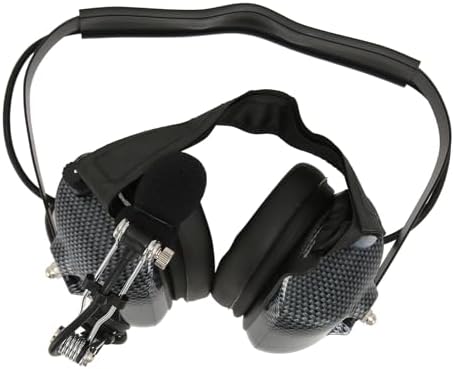
That makes headset connectivity an important feature for pilots planning to use a portable radio in an aircraft.
Some radios require an adapter cable for a standard aviation headset.
Others provide aviation headset connections directly on the radio.
If your handheld is intended as an emergency backup, practice connecting your normal aviation headset to it before you actually need the radio. Know exactly where any required adapter is stored.
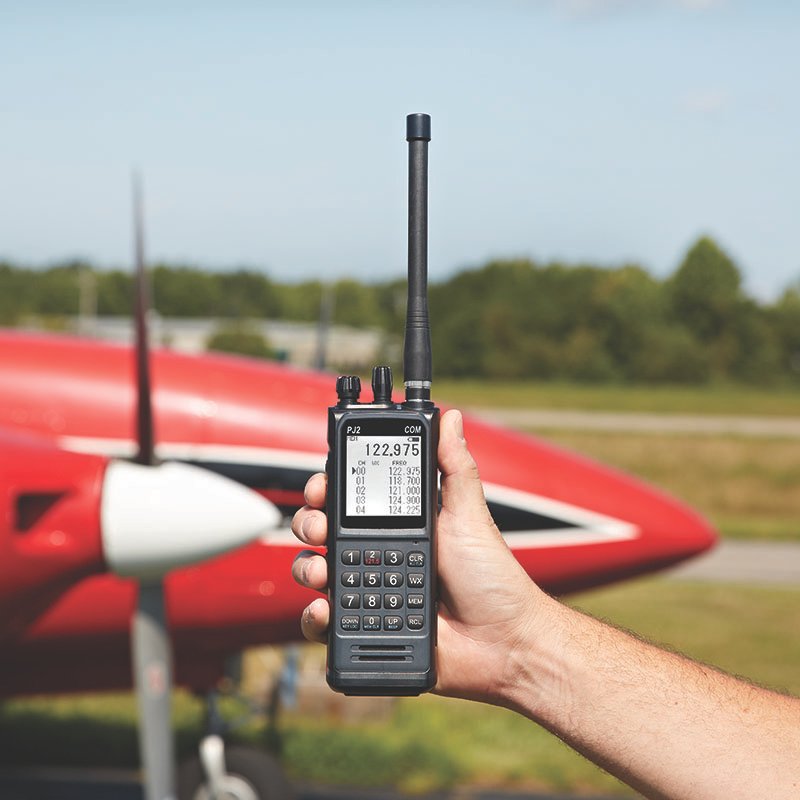
4. Sporty’s PJ2+ — Simple Backup Communication
The Sporty’s PJ2+ takes a deliberately simple approach.
It is a COM-only handheld aviation radio rather than a portable navigation system.
One of its most distinctive features is the inclusion of standard twin GA headset jacks directly on the radio.
That allows a pilot using a compatible standard GA headset to disconnect it from the aircraft panel and connect it directly to the PJ2+ without a separate headset adapter.
It also provides a 3.5 mm audio jack.
PJ2+ Key Features
- COM-only aviation radio
- 118.000 to 136.975 MHz communication frequencies
- 6 watts PEP published transmit power
- Built-in standard twin GA headset jacks
- 3.5 mm headset/earbud jack
- Large backlit display and keypad
- 20 memory channels
- NOAA weather band
- 121.5 emergency-frequency button
- Six-AA battery pack
- USB-C external power capability
Its main attraction is not having the longest feature list. It is designed around straightforward backup communication.
5. Why Direct Headset Jacks Are Useful
A built-in aviation headset connection can simplify a backup-radio setup.
Instead of searching through a flight bag for an adapter, a compatible GA headset can be connected directly to the PJ2+.
For pilots using conventional dual-plug GA headsets, that can be a meaningful convenience.
However, pilots using other headset connections should verify compatibility before buying.
6. USB-C Power on a Backup Radio
The PJ2+ can operate from six AA batteries and also accepts USB-C external power.
According to Sporty’s, USB-C powers the radio but does not charge the installed AA battery pack.
This gives pilots another potential power source, such as a compatible external battery pack or aircraft USB power supply.
For a device that may spend long periods inside a flight bag, widely available AA batteries can also be attractive.
7. Icom IC-A25N — More Than a Simple COM Radio
The Icom IC-A25N takes a different approach.
Rather than focusing only on basic backup communication, it combines NAV and COM functionality with additional navigation and connectivity features.
Icom lists built-in GPS, Bluetooth and VOR navigation among the A25N’s features.
Icom IC-A25N Key Features
- NAV and COM capability
- Built-in GPS
- GPS waypoint navigation
- VOR navigation functions
- Bluetooth
- 6 watts PEP published transmit power
- 2.3-inch display
- 300 memory channels
- 121.5 MHz emergency key
- Weather channels
- Rechargeable Li-ion battery
- Optional AA battery case
- IP57-rated construction
That makes the IC-A25N particularly interesting for pilots who want their handheld to perform additional functions beyond basic voice communication.
8. Built-In GPS
The IC-A25N includes GPS functionality with simplified waypoint navigation.
Icom describes Direct-To and Flight Plan navigation modes using position information from satellite navigation.
This can add utility to the radio, but pilots should understand the intended role and limitations of portable equipment.
A handheld device does not automatically become a substitute for required or approved aircraft navigation equipment.
9. VOR Navigation
The A25N also includes VOR navigation functions.
Its display can present course-deviation information and TO/FROM indications, among other VOR-related functions.
For pilots interested in radio navigation, this gives the A25N functionality that a simple COM-only backup radio does not provide.
10. Bluetooth on a Handheld Aviation Radio
Bluetooth is another feature available on the IC-A25N.
Icom describes compatibility with supported Bluetooth accessories and hands-free operation features.
As always, compatibility should be checked before assuming a particular headset or device will work with the radio.
11. Icom Battery Options
The IC-A25N normally uses a rechargeable Li-ion battery pack.
Icom publishes up to approximately 10.5 hours of operating time under its specified test conditions.
The radio can also operate with six AA alkaline batteries when using the appropriate optional battery case.
This combination can appeal to pilots who like rechargeable power for regular use but also want access to commonly available batteries as an alternative.
12. Sporty’s PJ2 GPS — A Newer Approach
Pilots considering a Sporty’s radio now have another option beyond the COM-only PJ2+.
Introduced in 2026, the Sporty’s PJ2 GPS expands the PJ2 concept with additional technology.
It adds features including GPS, Bluetooth audio, a color display and a built-in intercom while maintaining the portable-radio format.
That places it in a different category from the intentionally simple PJ2+.
13. Simple Radio or Feature-Rich Radio?
This is one of the most important questions in the buying process.
Keep It Simple
If the radio’s main purpose is emergency backup communication, straightforward controls and easy headset connection may be more valuable than advanced navigation features.
Add More Capability
If you expect to use the handheld regularly, GPS, navigation tools, Bluetooth and larger memory capacity may become more useful.
14. How Much Range Does a Handheld Aviation Radio Have?
There is no single reliable distance that applies to every handheld aviation radio.
VHF aviation communication is strongly affected by line of sight.
Your altitude, terrain, antenna orientation, aircraft structure, radio installation and the location of the station you are communicating with can all affect performance.
A handheld used from an aircraft at altitude may perform very differently from the same radio used from ground level.
15. Transmit Power Is Only Part of the Story
Pilots often compare radios by looking at wattage.
Transmit power matters, but it is only one factor.
Antenna efficiency, line of sight, altitude and surrounding structures can have a major impact on actual communication performance.
A radio advertised with a higher peak output does not automatically guarantee dramatically greater usable range in every situation.
16. Antenna Position
Portable radios normally rely on a relatively small antenna attached directly to the unit.
Inside an aircraft, your body and the aircraft structure can influence the signal.
Some pilots may have access to compatible external antenna arrangements, but any installation or connection should be appropriate for the equipment and aircraft.
17. Battery Type
Battery strategy is especially important for a device that may spend weeks or months waiting to be used.
There are advantages to both approaches.
| Power Type | Potential Advantage | Consideration |
|---|---|---|
| AA Batteries | Widely available and easy to keep as backup | Need to monitor condition and replacement intervals |
| Rechargeable Battery | Convenient for radios used frequently | Requires charging management |
| USB External Power | Can provide another power option | Requires compatible power source and cable |
| Multiple Options | Greater flexibility | May require additional battery cases or accessories |
18. Display Size and Readability
Cockpit lighting can range from bright sunlight to night conditions.
A display that looks great indoors may be harder to read in actual flying conditions.
Consider:
- Character size
- Backlighting
- Contrast
- Night mode
- Keypad illumination
- Frequency visibility
Simple visual design can be particularly useful when workload is high.
19. Emergency Frequency Access
Some handheld radios provide a dedicated or quick-access function for 121.5 MHz.
The PJ2+ and IC-A25N both include quick access to the emergency frequency among their documented features.
Know how your particular radio handles this function before relying on it.
20. Weather Channels
Some portable aviation radios include weather-channel reception.
This can add useful functionality where compatible weather broadcasts are available.
Availability and usefulness vary by region, so pilots should not assume that a weather feature provides the same information everywhere.
21. Memory Channels
Memory channels allow frequently used frequencies to be stored for faster access.
The importance of large memory capacity depends on how you intend to use the radio.
For a basic emergency radio, you may care much more about rapid manual frequency entry than storing hundreds of channels.
For regular use, larger memory capacity can become more valuable.
22. Water and Weather Resistance
Pilots who regularly operate outdoors or around changing weather conditions may value a more rugged radio.
Icom lists the IC-A25N with an IP57 rating.
However, an IP rating should always be interpreted according to the manufacturer’s stated testing conditions rather than as permission to treat electronics carelessly.
23. Size and Weight
A portable radio needs to fit into a flight bag without becoming an inconvenience.
But the smallest possible radio is not necessarily the easiest to use.
Larger buttons and screens can make operation easier, particularly in turbulence or while wearing gloves.
Balance portability against usability.
24. Best Handheld Radio for Student Pilots
Student pilots should first think about why they want the radio.
If the main objective is carrying an independent backup for communication, a straightforward COM radio may provide what they need without unnecessary complexity.
Students interested in learning more about VOR navigation and wanting additional portable navigation features may be attracted to a NAV/COM model.
Before purchasing, ask your flight instructor whether a handheld radio makes sense for your training environment.
25. Best Handheld Radio for Private Pilots
Private pilots who regularly fly cross-country may value a portable radio differently from someone who remains near the local airport.
Features such as independent battery power, weather reception, GPS or navigation capability may become more attractive depending on the type of flying.
The key is to avoid buying features simply because they exist.
26. Handheld Radios for Aircraft Owners
Aircraft owners may view a handheld as part of a broader collection of backup equipment.
They may also have more flexibility to consider external antenna arrangements or cockpit power options when appropriate and properly installed.
Any modification or permanent aircraft installation should follow applicable requirements and appropriate maintenance practices.
27. Handheld Radios for Renters
Pilots who frequently move between rental aircraft may value portability and compatibility more highly.
A radio that works independently of the aircraft’s electrical system can remain in the pilot’s own flight bag regardless of which aircraft is being flown.
Headset compatibility is especially worth considering if you regularly switch airplanes.
28. Don’t Leave the Radio Untested for Years
Buying emergency equipment and forgetting about it can create false confidence.
Periodically inspect the radio and its accessories.
Check:
- Battery condition
- Battery compartment
- Charging status when applicable
- Antenna condition
- Headset adapters
- Power cables
- Controls and display
Follow the manufacturer’s instructions for testing, storage and maintenance.
29. Practice Using It
Knowing that a radio is somewhere in your flight bag is different from knowing how to operate it.
Become familiar with:
- Turning it on
- Adjusting volume and squelch
- Entering a frequency
- Changing frequencies
- Connecting your headset
- Using push-to-talk
- Checking battery status
- Accessing emergency-frequency functions
Familiarity reduces the amount of attention required if you ever need the device unexpectedly.
30. Where Should You Keep It?
A backup radio buried underneath luggage is not very convenient.
Consider storing it somewhere accessible within your normal flight-bag organization.
Protect the radio and antenna from damage while making sure required cables or adapters stay with the device.
Handheld Aviation Radio Comparison
| Radio | Best Suited To | Notable Features |
|---|---|---|
| Sporty’s PJ2+ | Pilots prioritizing straightforward backup COM | COM-only, direct GA headset jacks, AA batteries, USB-C power, simple controls |
| Icom IC-A25N | Pilots wanting more navigation functionality | NAV/COM, GPS, VOR functions, Bluetooth, rechargeable battery, optional AA case |
| Sporty’s PJ2 GPS | Pilots wanting the PJ2 concept with newer connected features | GPS, Bluetooth audio, color display, built-in intercom and portable COM functionality |
What Should You Look For Before Buying?
Handheld Aviation Radio Checklist
- COM-only or NAV/COM?
- Is operation simple and intuitive?
- Can I connect my aviation headset?
- Does it require an adapter?
- What batteries does it use?
- Can it use common AA batteries?
- Does it support external power?
- How readable is the display?
- Is there quick access to 121.5?
- Does it include weather-channel reception?
- Do I actually need GPS?
- Do I need VOR navigation?
- Would Bluetooth be useful?
- How rugged is the radio?
- Will I practice using it regularly?
Which Type Makes the Most Sense?
| Your Priority | What to Consider |
|---|---|
| Simple backup communication | COM-only radio with easy controls |
| Direct GA headset connection | Radio with built-in compatible headset jacks |
| Navigation features | NAV/COM radio |
| GPS functionality | GPS-equipped model |
| VOR capability | NAV-capable radio such as an appropriate NAV/COM model |
| Battery flexibility | Model supporting multiple power options |
| Modern connectivity | Bluetooth-equipped model |
| Emergency simplicity | Large controls, readable screen and uncomplicated frequency entry |
Is a Handheld Aviation Radio Worth Carrying?
For many pilots, the attraction is independence.
A portable radio has its own antenna and power source and can remain in your flight bag regardless of which aircraft you fly.
That does not guarantee communication in every situation, and it does not replace proper aircraft equipment.
But as a supplemental communication tool, many pilots consider a handheld radio useful enough to reserve space for one in the flight bag.
Frequently Asked Questions
Do pilots need a handheld aviation radio?
Not every pilot needs to personally own one, and requirements depend on the operation. However, many pilots choose to carry a portable radio as an additional communication option and backup tool.
Can a handheld aviation radio replace the aircraft radio?
A portable radio should not automatically be treated as a replacement for required, approved or properly maintained aircraft communication equipment. It is generally better viewed as supplemental portable equipment.
How far can a handheld aviation radio transmit?
There is no universal range. VHF communication depends heavily on line of sight, altitude, terrain, antenna position, aircraft structure and other conditions. Published transmitter power alone does not determine real-world range.
What is the difference between COM and NAV/COM?
A COM radio focuses on aviation voice communication. A NAV/COM radio combines communication with compatible navigation functions, which vary by model.
Does the Icom IC-A25N have GPS?
Yes. Icom lists built-in GPS with simplified waypoint navigation among the IC-A25N’s features. It also includes VOR navigation functions and Bluetooth.
Does the Sporty’s PJ2+ have GPS?
No. The PJ2+ is a COM-focused radio without GPS or NAV functionality. Sporty’s also offers the newer PJ2 GPS for pilots looking for additional GPS and connectivity features.
Can I plug my aviation headset into a handheld radio?
It depends on the radio and headset. The PJ2+ includes standard twin GA headset jacks directly on the radio. Other radios may require a compatible adapter or use a different connection.
Should a backup radio use AA batteries?
AA batteries can be convenient because they are widely available and easy to store as spares. Rechargeable systems can also be practical, particularly when the radio is used frequently. Some models provide more than one power option.
Choose the Radio for the Job You Actually Need
A pilot looking for straightforward backup communication may not need GPS, Bluetooth or sophisticated navigation functions.
On the other hand, pilots who expect to use their handheld regularly may appreciate having NAV capability, GPS, larger memory capacity and additional connectivity.
Start by deciding what role the radio will play in your flight bag. Then compare communication capability, headset compatibility, battery options, controls, navigation features and portability.
The best handheld aviation radio is not necessarily the one with the longest specification sheet. It is the one you understand, keep ready and can operate confidently when you need it.