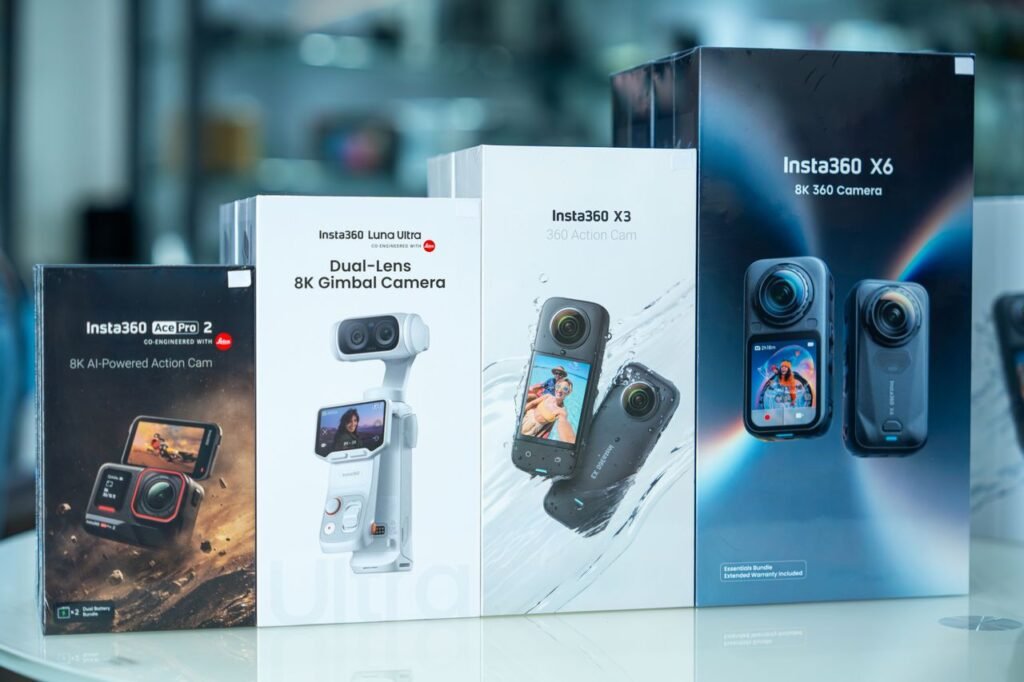
Pocket gimbal cameras have become attractive travel companions for people who want smooth, high-quality video without carrying a large camera, multiple lenses and a separate stabilizer.
DJI helped popularize this category with the Osmo Pocket series. In 2026, Insta360 entered the competition with its Leica co-engineered Luna cameras, bringing new features such as 8K recording, detachable screens and, on the Luna Ultra, a dedicated telephoto camera.
But does newer technology automatically make the Insta360 Luna better than the DJI Osmo Pocket 3?
In this comparison, we examine image quality, stabilization, zoom, battery life, portability, audio and travel convenience to help you decide which camera makes the most sense.
Quick answer: The DJI Osmo Pocket 3 remains an attractive choice for travellers who value compact size, straightforward controls and an established DJI workflow. The Insta360 Luna Pro offers 8K recording, a detachable screen and built-in storage. The Luna Ultra adds a dedicated telephoto camera, making it especially interesting for travellers who frequently film distant subjects or want more framing options.
Meet the Three Cameras
DJI Osmo Pocket 3
A compact 1-inch sensor camera with a three-axis mechanical gimbal, 4K recording, a rotating touchscreen and DJI ActiveTrack 6.0.
Insta360 Luna Pro
A newer Leica co-engineered camera with a 1-inch sensor, 8K recording, detachable OLED touchscreen and 47GB internal storage.
Insta360 Luna Ultra
The flagship Luna model adds a second telephoto camera, expanding framing options for travel videos and distant subjects.
Which Is Best?
That depends on whether you prioritize portability, advanced recording features, zoom versatility or your existing camera ecosystem.
1. DJI Osmo Pocket 3: Why It Still Matters
The Osmo Pocket 3 combines a 1-inch CMOS sensor with a three-axis mechanical gimbal in a small handheld camera.
Its 2-inch rotating touchscreen makes it easy to switch shooting orientation, review framing and access settings.
The camera supports standard 4K recording up to 60 frames per second, with 4K/120fps available in Slow Motion mode.
DJI also includes ActiveTrack 6.0, designed to help keep selected subjects in frame while recording.
2. Insta360 Luna Pro: A New Alternative
Released in September 2026, the Insta360 Luna Pro brings several features that make it particularly interesting for travel content creators.
These include a 1-inch sensor, Leica Summicron optics, 8K recording, 4K vertical video, AI-powered tracking and a detachable 2-inch OLED screen.
It also includes 47GB of internal storage, which can be useful when travelling without a spare memory card.
3. Insta360 Luna Ultra: The Telephoto Advantage
The Luna Ultra adds a second camera to the Luna design.
Its main camera uses a 1-inch sensor and a 20mm-equivalent lens.
The additional telephoto camera uses a 1/1.3-inch sensor and a 60mm-equivalent lens.
This gives travellers more flexibility when filming architecture, street details, distant landmarks and other subjects that cannot easily be approached.
4. Camera Specification Comparison
| Feature | DJI Pocket 3 | Luna Pro | Luna Ultra |
|---|---|---|---|
| Main sensor | 1-inch CMOS | 1-inch | 1-inch |
| Main lens | 20mm equivalent, f/2.0 | 20mm equivalent, f/1.8 | 20mm equivalent, f/1.8 |
| Additional telephoto camera | No | No | Yes, 60mm equivalent |
| Maximum advertised video resolution | 4K | 8K | 8K |
| Mechanical stabilization | 3-axis | 3-axis | 3-axis |
| Touchscreen | 2-inch rotating | 2-inch detachable OLED | 2-inch detachable OLED |
| Weight | 179g | Approximately 215–218g | Approximately 233–235g |
| Built-in storage | No | 47GB | 47GB |
| Manufacturer-rated battery life | Up to 166 minutes | Up to 240 minutes | Up to 240 minutes |
Battery figures above come from laboratory tests at 1080p/24fps with the screen and Wi-Fi turned off. Actual endurance will vary, particularly when recording higher-resolution footage.
5. Is 8K Better Than 4K for Travel?
Both Luna cameras advertise 8K recording, while the DJI Osmo Pocket 3 is a 4K camera.
8K can be useful when you want extra resolution for cropping, reframing or delivering detailed footage.
However, higher resolution also brings practical considerations.
- Larger video files
- Greater storage requirements
- More demanding editing
- Potentially higher power consumption
- More demanding export workflows
For many travellers sharing videos on social media or watching on a phone, well-recorded 4K footage may be more than sufficient.
Choose recording resolution based on your final video, not simply the largest number advertised on the box. Reliable 4K footage with good composition and audio is often more useful than difficult-to-manage 8K files.
6. Does Sensor Size Tell the Whole Story?
All three cameras have a 1-inch-class main sensor.
Sensor size matters, but it does not independently determine image quality.
Lens design, processing, exposure, dynamic range, color science and shooting conditions also influence the result.
A camera with higher maximum resolution does not automatically produce better footage in every lighting condition.
7. Low-Light Video
Travel filming often continues after sunset.
Restaurants, evening streets, hotel interiors and city skylines can be challenging environments for small cameras.
The Pocket 3 uses a 1-inch sensor with an f/2.0 lens, while the Luna models use a 1-inch main sensor with an f/1.8 lens.
The wider advertised aperture of the Luna main lens is one specification worth considering, but it does not prove superior overall low-light performance without controlled comparisons.
8. Stabilization: Why a Mechanical Gimbal Matters
A mechanical gimbal helps keep the camera oriented smoothly while the person holding it moves.
Unlike software-only stabilization, the camera physically compensates for movement across multiple axes.
All three cameras use three-axis mechanical stabilization.
This makes them suitable for walking shots, travel introductions, hotel walkthroughs and other situations where handheld motion needs to look controlled.
9. Which Camera Has the Best Stabilization?
Specifications alone cannot establish a universal winner.
Stabilization quality depends on movement, tracking behavior, software tuning and how the operator handles the camera.
The Pocket 3 has an established DJI gimbal workflow, while the Luna series offers its own three-axis system with AI-powered subject tracking.
For a meaningful comparison, look for independent footage filmed under similar walking, panning and tracking conditions.
10. Subject Tracking for Solo Travel
If you film yourself, subject tracking can be one of the most useful camera features.
The DJI Pocket 3 offers ActiveTrack 6.0.
The Insta360 Luna series offers AI-powered tracking features including Deep Track.
Both approaches aim to keep a moving subject properly framed while the camera’s gimbal adjusts.
11. Detachable Screen vs Rotating Screen
This is one of the most interesting design differences.
The Pocket 3 has a rotating 2-inch OLED touchscreen attached to the camera.
The Luna Pro and Ultra feature detachable 2-inch OLED touchscreens.
A detachable display can make it easier to monitor certain camera angles without standing directly behind the device.
That can be useful for solo creators filming themselves or setting up shots from unusual positions.
12. Portability and Weight
For travel, weight and size matter.
According to manufacturer specifications:
- DJI Osmo Pocket 3: 179g
- Insta360 Luna Pro: approximately 215–218g
- Insta360 Luna Ultra: approximately 233–235g
The DJI is the lightest of these three cameras.
That difference may be especially relevant to travellers who want to carry the camera in a small bag or use it for extended handheld recording.
13. Which Camera Is Easier to Carry?
The Pocket 3 has a clear weight advantage.
However, the Luna Ultra combines its additional telephoto camera into one device.
A traveller who would otherwise carry another camera or accessory for tighter shots may appreciate that flexibility.
The better travel setup depends on the equipment you would otherwise bring.
14. Zoom: A Major Difference
The Pocket 3 relies on digital zoom.
The Luna Pro also uses its main camera for zoom and reframing options.
The Luna Ultra stands apart because it includes a dedicated 60mm-equivalent telephoto camera in addition to its main 20mm-equivalent camera.
This can be useful for capturing distant details without moving physically closer.
15. When Telephoto Is Useful for Travel
A telephoto perspective can be useful for:
- Architectural details
- Distant buildings
- Street photography
- Travel B-roll
- Portrait-style framing
- Landscape details
It is less important if you primarily film yourself talking to the camera at arm’s length.
16. Battery Life Comparison
DJI rates the Pocket 3 for up to 166 minutes under its specified low-power test conditions.
Insta360 rates both Luna models for up to 240 minutes under its own 1080p/24fps laboratory conditions.
These are manufacturer ratings rather than directly comparable real-world endurance tests.
High-resolution recording, active screens, wireless features and ambient temperature can reduce actual runtime.
17. Charging Speed
DJI states that the Pocket 3 can reach approximately 80% charge in 16 minutes with the specified compatible charging equipment.
Insta360 lists approximately 23 minutes to reach 80% for the Luna models under its stated laboratory charging conditions.
Both are designed for relatively fast charging, but charging performance depends on the power source and accessories.
18. Can You Replace the Batteries?
These cameras use integrated battery designs rather than conventional quick-swap camera batteries.
For extended travel days, consider compatible charging accessories and an appropriate USB-C power bank.
If flying, check current airline and aviation-security rules for carrying lithium batteries and power banks.
19. Built-In Storage
The Luna Pro and Ultra include 47GB of built-in storage and support external microSD storage.
The DJI Pocket 3 requires a compatible microSD card for recording.
Built-in storage is convenient if you forget your memory card, but it should not replace a proper backup workflow.
20. Storage for 8K Video
8K recording can consume substantial storage.
If you plan to record extensively in high resolution, consider:
- Compatible high-speed memory cards
- Storage capacity
- File transfer speed
- Backup storage
- Editing-device performance
Do not assume that a memory card suitable for basic 1080p recording is appropriate for every high-bitrate video mode.
21. Audio Quality and Microphones
Good travel video needs good audio.
The Pocket 3 has three built-in microphones and supports compatible DJI wireless microphone products.
The Luna series has four microphones according to Insta360’s hardware specifications, including one on the detachable touchscreen remote.
The Luna series also supports compatible Insta360 microphone accessories.
Microphone count alone does not establish recording quality. Wind handling, microphone placement and recording environment are also important.
22. External Microphones for Vlogging
For travel creators who speak directly to the camera, a wireless microphone can be a valuable upgrade.
Before purchasing, verify which microphone models and connection methods are officially supported by your chosen camera.
If you already own a DJI microphone system, the Pocket 3 may offer an easier workflow.
If you use compatible Insta360 audio equipment, a Luna camera may integrate more naturally into your setup.
23. Vertical Video for Social Media
Both camera families provide tools for shooting vertical content.
The Pocket 3 uses its rotating screen and supported vertical shooting modes.
The Luna Pro includes a dedicated 4K vertical recording feature, which Insta360 highlights for short-form creators.
If you primarily create Instagram Reels, YouTube Shorts or TikTok videos, check the exact resolution and frame-rate options for the vertical mode you plan to use.
24. Editing and Color Profiles
The Pocket 3 supports recording options including 10-bit D-Log M and HLG.
The Luna Pro offers 10-bit I-Log and Leica color profiles, with workflow features aimed at more advanced editing.
These options can be useful when you want to color-grade footage rather than rely exclusively on automatic camera output.
However, advanced profiles require a suitable editing workflow and are not automatically better for someone who wants to publish a video immediately.
25. Which Is Easier for Beginners?
Beginners should consider more than technical specifications.
Useful questions include:
- How quickly can I start recording?
- Can I frame myself easily?
- Are the menus understandable?
- Can I transfer files to my phone?
- Does the camera work with my existing microphone?
- Can I edit the footage on my current computer?
The DJI Pocket 3 offers a relatively straightforward established design.
The Luna Pro adds newer features without requiring the dual-camera complexity of the Ultra.
26. Which Is Best for Family Vacations?
Family travel often involves spontaneous moments.
A good camera should be easy to carry, fast to start and simple to use.
The Pocket 3 is appealing because of its lower weight and straightforward recording approach.
The Luna Pro is worth considering if you also want 8K recording, built-in storage and the flexibility of a detachable screen.
27. Which Is Best for Solo Travel Vlogs?
Solo creators frequently need to operate the camera while appearing in the shot.
Subject tracking and screen visibility become especially important.
The Pocket 3 offers ActiveTrack 6.0 and a rotating screen.
The Luna models offer AI-powered tracking and a detachable touchscreen.
If remote framing is central to your workflow, the Luna design deserves particular attention.
28. Which Is Best for City Travel?
City travel involves walking footage, architecture, street scenes and night recording.
All three cameras can handle stabilized walking footage.
The Luna Ultra’s dedicated telephoto camera provides additional flexibility when filming architectural details or subjects across a street or plaza.
The Pocket 3 remains attractive if keeping your setup lightweight is more important than additional zoom options.
29. Which Is Best for Hiking?
All three cameras can produce stabilized handheld footage.
However, they are not rugged action cameras.
The Insta360 Luna Pro and Ultra are explicitly described by their manufacturer as not waterproof, splashproof or dustproof.
The Pocket 3 should likewise be protected from water, sand and harsh environmental conditions.
30. Which Is Best for Beach Vacations?
For beach travel, sand and water exposure should be major considerations.
A pocket gimbal camera can be excellent for controlled beach footage away from spray and blowing sand.
For swimming, snorkeling, surfing or situations where the camera may get wet, a suitable waterproof action camera is generally the more appropriate category.
31. Which Is Best for Travel Photography?
Although these devices are video-oriented, they can also capture still images.
The Luna cameras offer higher-resolution imaging specifications and the Ultra provides an additional focal length.
The Pocket 3 provides convenient still-photo modes, including panoramas.
If photography is your primary goal rather than video, also compare these devices with a dedicated compact camera or smartphone.
32. What About the Price?
Insta360 announced the Luna Pro Standard Bundle at a starting price of US$599.99 in September 2026.
The Luna Ultra occupies the higher-end position in the lineup, while the Pocket 3 may be available through different bundles and regional promotions.
Because prices vary by country, retailer, bundle and promotion, compare the current total price rather than relying on a single launch figure.
Also check which accessories are included.
33. Compare the Complete Kit
Two cameras with similar advertised prices may come with different accessories.
Check for:
- Protective case
- Handle or grip
- Microphone
- Charging accessories
- Memory card
- Tripod
- Filters
- Extended warranty options
A cheaper camera may not remain cheaper once you add the accessories required for your workflow.
34. Advantages of DJI Osmo Pocket 3
Why Choose the Pocket 3?
- Lightest camera in this comparison
- 1-inch CMOS sensor
- Three-axis mechanical stabilization
- 4K recording with 4K/120fps slow motion
- Rotating 2-inch touchscreen
- ActiveTrack 6.0
- Compatible DJI microphone ecosystem
- Fast manufacturer-rated charging
- Suitable for straightforward travel vlogging
35. Limitations of DJI Osmo Pocket 3
The Pocket 3 does not offer the 8K recording advertised by the Luna cameras.
It also lacks a dedicated telephoto camera, a detachable touchscreen and built-in recording storage.
These limitations matter more to some creators than others.
36. Advantages of Insta360 Luna Pro
Why Choose the Luna Pro?
- 1-inch sensor with Leica co-engineered optics
- 8K recording capability
- Dedicated 4K vertical recording
- Three-axis mechanical stabilization
- Detachable 2-inch OLED touchscreen
- AI-powered subject tracking
- 47GB built-in storage
- Manufacturer-rated battery life up to 240 minutes
- Advanced color and editing options
37. Limitations of Insta360 Luna Pro
The Luna Pro is heavier than the Pocket 3 and does not include the Ultra’s dedicated telephoto camera.
Its 8K files may also require more storage and processing resources.
As a newer product, buyers should verify current firmware, accessories and regional service options.
38. Advantages of Insta360 Luna Ultra
Why Choose the Luna Ultra?
- Dual-camera design
- 20mm-equivalent main camera
- 60mm-equivalent telephoto camera
- 8K-capable main imaging system
- Three-axis stabilization
- Detachable touchscreen
- 47GB built-in storage
- Advanced creator-oriented recording features
- Greater framing versatility for travel footage
39. Limitations of Insta360 Luna Ultra
The Ultra is the heaviest camera in this comparison.
Its additional camera and advanced features may also be unnecessary for creators who mainly record simple walking videos or talking-head travel content.
Before choosing it, ask whether you will actually use the telephoto camera often enough to justify the additional size and cost.
40. Which Camera Should You Buy?
| Your Priority | Camera to Consider |
|---|---|
| Lowest weight | DJI Osmo Pocket 3 |
| Simple travel vlogging | DJI Osmo Pocket 3 |
| 8K without a second camera | Insta360 Luna Pro |
| Detachable screen | Insta360 Luna Pro or Ultra |
| Dedicated telephoto lens | Insta360 Luna Ultra |
| Built-in storage | Insta360 Luna Pro or Ultra |
| Existing DJI microphone workflow | DJI Osmo Pocket 3 |
| Travel footage with varied focal lengths | Insta360 Luna Ultra |
41. Buying Checklist
Before You Purchase
- Decide whether 4K is enough for your videos.
- Consider whether you need 8K.
- Decide whether a telephoto camera is important.
- Compare weight and dimensions.
- Review screen design and tracking features.
- Check microphone compatibility.
- Compare real-world battery tests.
- Confirm memory-card requirements.
- Review editing-software compatibility.
- Check local prices and bundles.
- Confirm warranty and regional support.
- Protect the gimbal from water, dust and impacts.
Official Manufacturer Sources
For complete technical specifications and current product availability, visit:
- DJI Osmo Pocket 3 Official Product Page
- DJI Osmo Pocket 3 Technical Specifications
- Insta360 Luna Pro Official Announcement
- Insta360 Luna Ultra Official Announcement
- Insta360 Luna Series Hardware Specifications
Frequently Asked Questions
Is the Insta360 Luna better than the DJI Osmo Pocket 3?
Not automatically. The Luna Pro and Ultra offer newer features such as 8K recording, detachable screens and built-in storage. The Pocket 3 is lighter and may be a better fit for travellers who prioritize a straightforward workflow.
What is the difference between Luna Pro and Luna Ultra?
The most important difference is the Luna Ultra’s additional telephoto camera. Both have a 1-inch main sensor, 8K recording capability, three-axis stabilization and a detachable touchscreen.
Does DJI Osmo Pocket 3 record 8K?
No. The Pocket 3 supports up to 4K recording, including 4K/120fps in Slow Motion mode.
Does Insta360 Luna Pro record 8K?
Yes. Insta360 advertises 8K recording for the Luna Pro.
Which camera is lighter?
The DJI Osmo Pocket 3 weighs 179g, compared with approximately 215–218g for the Luna Pro and 233–235g for the Luna Ultra.
Which camera is better for zoom?
The Luna Ultra is the most versatile option here because it includes a dedicated 60mm-equivalent telephoto camera in addition to its main camera.
Are these cameras waterproof?
No. These pocket gimbal cameras should be protected from water, sand and dust. The Luna series is explicitly rated as not waterproof or splashproof.
Is 8K necessary for travel videos?
Not for everyone. 8K can help with cropping and high-resolution production, but 4K is often sufficient for travel vlogs and social-media content.
Which camera is better for solo vloggers?
Both families offer subject tracking. The Luna series adds a detachable screen that may be particularly useful for certain solo filming setups, while the Pocket 3 offers ActiveTrack 6.0 and a rotating touchscreen.
Which is best for beginners?
The DJI Pocket 3 is a strong option for straightforward filming. The Luna Pro is worth considering if a beginner also wants advanced features such as 8K recording and a detachable screen.
Final Verdict: Choose the Camera That Fits Your Travels
The DJI Osmo Pocket 3, Insta360 Luna Pro and Insta360 Luna Ultra are all designed around a similar idea: producing smooth, high-quality video without the size of a traditional camera-and-gimbal setup.
Choose the DJI Osmo Pocket 3 if portability, simplicity and an established DJI workflow are your main priorities.
Consider the Insta360 Luna Pro if you want 8K recording, a detachable screen and built-in storage without paying for a dual-camera system you may not need.
Consider the Insta360 Luna Ultra if its dedicated telephoto camera would genuinely improve the travel footage you create.
The best camera is not necessarily the one with the most impressive specification sheet. It is the one you will comfortably carry, operate and use throughout your trip.